
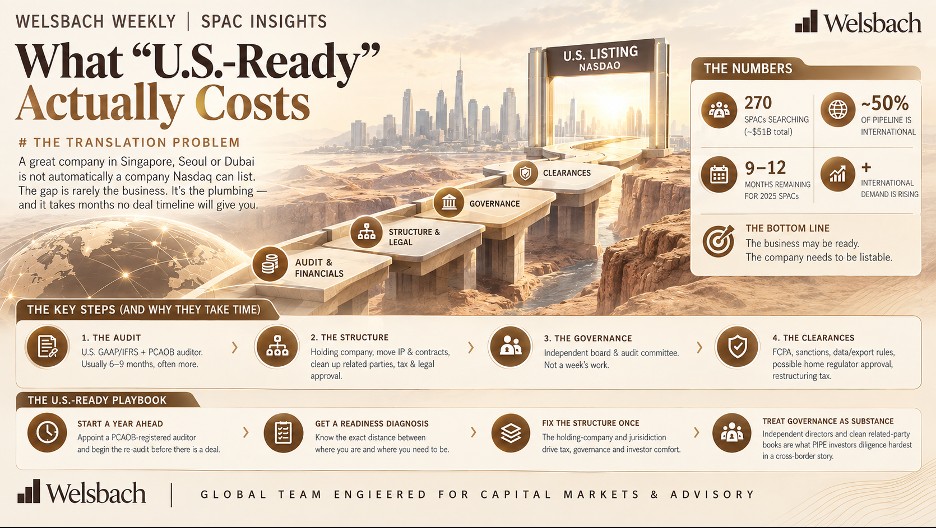
A great company in Singapore, Seoul or Dubai is not automatically a company Nasdaq can list. The gap is rarely the business. It's the plumbing, and it takes months no deal timeline will give you.
Originally published on Welsbach SPACtacular Insights (Substack)
| The Numbers | Value |
|---|---|
| SPACs searching | 270 (~$51B total) |
| Share of pipeline that is international | ~50% |
| Months remaining for 2025 SPACs | 9-12 |
| International demand | Rising |
| The bottom line | The business may be ready. The company needs to be listable. |
A sponsor calls a company in Singapore, or Seoul, or Dubai. The business is real: good revenue, a defensible product, a market the U.S. would pay to own a piece of. Both sides are enthusiastic. Then diligence starts, the deal slows, and eventually it stalls.
Not because the company isn't good, because it isn't listable, not yet, not in the form U.S. public markets require. This is the quiet killer of cross-border deals. The business was ready. The company was not. And the distance between the two is measured in months of unglamorous work that no deal timeline will give you.
The Call Is Coming
Demand for international targets is real and rising. Last week we wrote that 270 SPACs are hunting on a clock, sitting on roughly $51 billion. A large share of what they are hunting sits offshore.
The August pipeline shows it plainly. Announced and live deals run through Nanyang Biologics (healthcare, Asia), Super Apps Holdings (financial, Asia), Leading Group (Asia), XDATA and GreenRock (Europe), Sio Silica (global); Pasqal and IQM closed out of Europe and beyond. The reopened U.S. market and the sponsor's deadline mean the international company now gets approached, whether or not it went looking.
So the question has changed. It is no longer "can we access U.S. markets." It is "are we in listable form when the approach comes." Most companies discover the answer is no at the worst possible moment, after the clock has already started.
Impressive Doesn't Clear the Bar
Being courted is not being ready. When diligence opens, a company built for its home market meets a standard built for U.S. public companies, and the gaps surface fast.
The accounts are kept on local GAAP and audited by a firm the U.S. regulator has never registered. Related-party dealings and founder loans are threaded through the business. The cap table carries instruments that don't translate cleanly. IP and key contracts sit in the wrong entity. The board is the founder and two friends.
Then come the structural questions that are specific to operating across borders. Is there a foreign-ownership cap that forces a contractual-control workaround the U.S. market distrusts? Do the statutory accounts filed with the home regulator reconcile to what the SEC will see? How does cash actually move out of the operating country, and what does transfer pricing look like under scrutiny? Each of these is answerable. None is answerable in the weeks a sponsor on a deadline can spare.
None of this means the business is weak. All of it means the company cannot pass U.S. disclosure and audit as it stands. Enthusiasm and leverage are worth nothing if the company can't clear the bar and for an international company, the bar is higher, stranger, and further away than most founders expect.
The Long Poles Are Months, Not Weeks
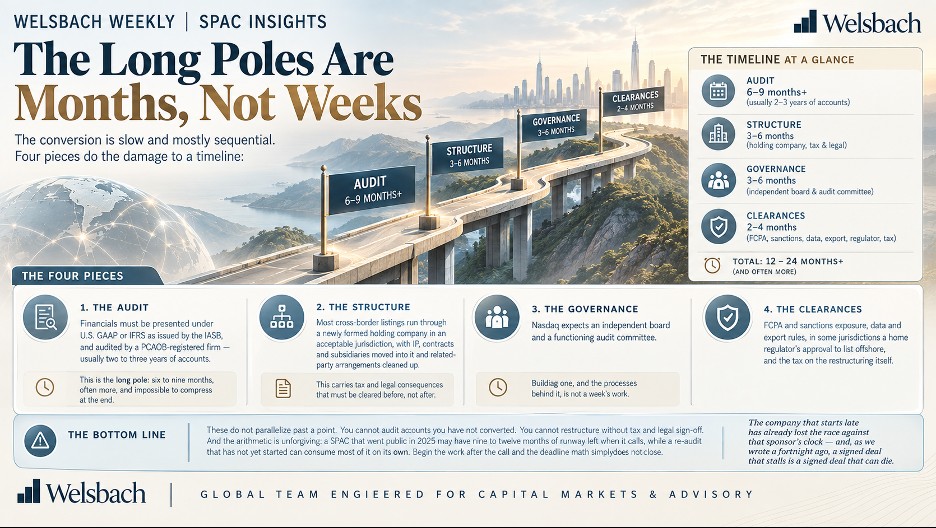
| The Timeline at a Glance | Typical duration |
|---|---|
| Audit | 6-9 months+ (usually 2-3 years of accounts) |
| Structure | 3-6 months (holding company, tax and legal) |
| Governance | 3-6 months (independent board and audit committee) |
| Clearances | 2-4 months (FCPA, sanctions, data, export, regulator, tax) |
| Total | 12-24 months+ (and often more) |
The conversion is slow and mostly sequential. Four pieces do the damage to a timeline:
- The audit. Financials must be presented under U.S. GAAP or IFRS as issued by the IASB, and audited by a PCAOB-registered firm, usually two to three years of accounts. This is the long pole: six to nine months, often more, and impossible to compress at the end.
- The structure. Most cross-border listings run through a newly formed holding company in an acceptable jurisdiction, with IP, contracts and subsidiaries moved into it and related-party arrangements cleaned up. That restructuring carries tax and legal consequences that must be cleared before, not after.
- The governance. Nasdaq expects an independent board and a functioning audit committee. Building one, and the processes behind it, is not a week's work.
- The clearances. FCPA and sanctions exposure, data and export rules, in some jurisdictions a home regulator's approval to list offshore, and the tax on the restructuring itself.
These do not parallelize past a point. You cannot audit accounts you have not converted. You cannot restructure without tax and legal sign-off. And the arithmetic is unforgiving: a SPAC that went public in 2025 may have nine to twelve months of runway left when it calls, while a re-audit that has not yet started can consume most of it on its own. Begin the work after the call and the deadline math simply does not close. The company that starts late has already lost the race against that sponsor's clock and, as we wrote a fortnight ago, a signed deal that stalls is a signed deal that can die.
Translate Before You Pitch
The international companies that make it to a listing do a few specific things, and they do them early.
- They start the translation a year ahead. Appoint the PCAOB-registered auditor and begin the re-audit before there is a deal to audit for. It is the single highest-leverage move an international company can make.
- They get a readiness diagnosis first. Know the exact distance between where the company is and where it must be before talking to a sponsor. A founder who can show an auditor already engaged and a clean structure walks into the room as a credible counterparty; one who cannot is a project the sponsor must underwrite on faith. That is the difference between an approach that becomes leverage and one that becomes a scramble.
- They fix the structure once. The holding-company and jurisdiction decision drives tax, governance and investor comfort. Redoing it mid-deal is how timelines die.
- They treat governance as substance. Independent directors and clean related-party books are exactly what PIPE investors diligence hardest in a cross-border story. Build them because they are real, not because a rulebook demands it.
Welsbach - Built for the Corridor
Welsbach operates at the intersection of two worlds: an international growth company with a compelling business at home, and a U.S. capital market with a specific and unforgiving definition of what a public company needs to be. Bridging that gap, across two accounting regimes, two governance cultures and at least two regulatory frameworks, is the corridor Welsbach was built to navigate.
The platform covers exactly this conversion: coordinating the PCAOB audit, managing the F-series filings with the SEC, restructuring the listing entity, building the board, and timing the whole effort against the right sponsor's clock through Target-to-SPAC Matching. Standing in the middle of the deal, our job is to make an international company listable before the window opens, so that when the call comes, it can say yes on its own terms rather than scramble to earn the right to.
From Research to Execution
Whether you're evaluating an investment, preparing for a transaction, conducting due diligence, or building materials for a client, it helps reduce the manual work involved in finding, validating, analyzing, and organizing financial information.
Brexy: The AI Operating System for Capital Markets
Brexy is an AI platform for capital markets that brings financial research, company data, documents, models, and institutional knowledge into one secure workspace.
Built for investment bankers, investors, deal teams, and financial advisors, Brexy helps teams research companies, analyze financial information, perform due diligence, build financial models, create investment materials, and move from analysis to execution faster.
One secure, finance-native environment. Less searching. Less switching. More work getting done.
Listable Is a Project, Not a Pitch
The demand is here, and it is not going away this quarter. The reopened market and the sponsor-on-the-clock dynamic mean the strong international company will keep getting the call.
The ones that actually list are not the most impressive in their home markets. They are the ones that did the quiet translation early, and had their accounts, their structure and their board in order before anyone asked to see them. Impressive is table stakes. Listable is a project. Start it before you need it, because the day a sponsor calls is the day it is already too late to begin.
Exploring growth capital or a U.S. listing? Partner with the Welsbach team to make it happen. Email contact@welsbach.sg or reach us through the contact page.
Download
Take this edition with you
Register once to download this Welsbach Weekly edition as a branded PDF, including all charts and exhibits.