
SPACs held 58% of U.S. IPOs year-to-date with 147 priced for $29 billion, 377 active vehicles holding $60.6 billion in trust and 107 live deals worth $63.1 billion, while a hawkish Jackson Hole put a September Fed hike back on the table.
Originally published on Welsbach SPACtacular Insights (Substack)
We spend hours researching and talking to the smartest founders, dealmakers and investors in the SPAC landscape. This is our attempt to give you a short 5-10 minute summary on how we are thinking about the macro, markets and SPACs, and what lies ahead. Hundreds of hours summarized, so you don't have to.
Quick Macro TL;DR
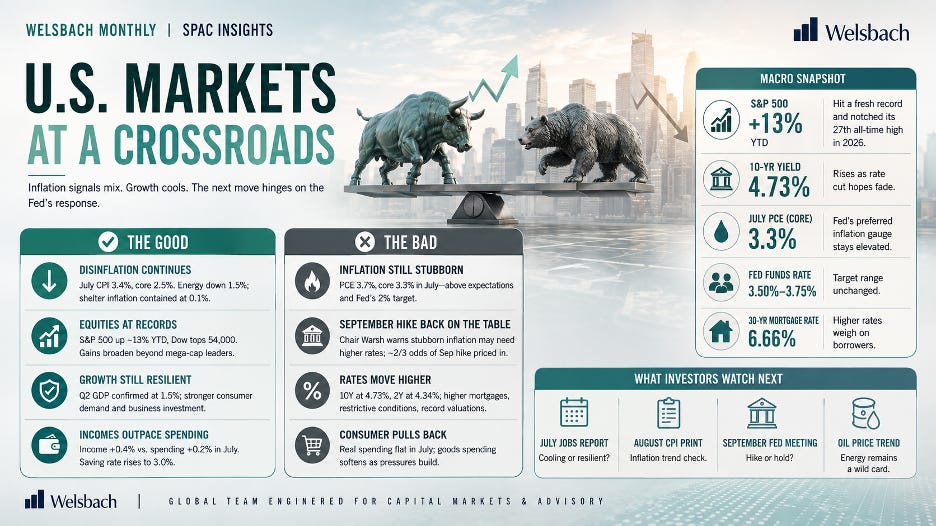
U.S. equities reached fresh highs despite persistent inflation pressures. July CPI eased to 3.4% and core CPI to 2.5%, while PCE remained firmer at 3.7% (core: 3.3%). At Jackson Hole, Fed Chair Kevin Warsh struck a hawkish tone, reinforcing concerns that sticky inflation could require tighter policy; September hike expectations rose to roughly two-thirds and the 10-year Treasury yield to 4.73%. With Q2 GDP at 1.5% and rates at 3.50-3.75%, markets remain balanced between record equity valuations, persistent inflation and slowing consumer momentum.
The Good
- Headline disinflation extended. July CPI rose just 0.1% on the month and eased to 3.4% year-over-year from 3.5%, while core CPI slowed to 2.5% from 2.6%. Energy prices fell 1.5% and shelter inflation stayed contained at 0.1%, the mildest monthly reading of the summer.
- Equities kept making history. The S&P 500 advanced to a fresh record and is up roughly 13% year-to-date, its 27th all-time high of 2026, while the Dow crossed 54,000 for the first time. Gains extended beyond the mega-cap leaders that drove the first half, a sign of broadening participation.
- Growth proved resilient rather than fragile. The second estimate of Q2 GDP was unrevised at 1.5%, but the Bureau of Economic Analysis lifted its read on both consumer demand and business investment, evidence that activity is cooling gradually rather than stalling.
- Incomes outpaced spending. Personal income rose 0.4% in July against a 0.2% gain in outlays, nudging the saving rate to 3.0%. A consumer rebuilding savings rather than drawing them down is a healthier foundation for the expansion than the spending-led momentum of prior quarters.
The Bad
- The Fed's preferred gauge stayed hot. Headline PCE held at 3.7% and core at 3.3% in July, each at or above forecast, keeping the Fed's inflation target visibly out of reach and undercutting the softer CPI signal.
- Warsh turned the September meeting live. At Jackson Hole, Chair Warsh signalled that persistent inflation may require additional tightening rather than easing, and CME futures moved to price roughly a two-thirds probability of a September hike, an outcome markets had all but dismissed weeks earlier.
- Rates re-tightened across the curve. The 10-year Treasury yield climbed to 4.73% and the two-year to 4.34%, with the 30-year fixed mortgage rate near 6.66%. Higher yields into a data-dependent Fed keep financial conditions restrictive precisely as valuations sit at records.
- The consumer began to flinch. Real spending was essentially flat in July as households absorbed firmer prices, and a pullback in goods outlays suggests the resilience underpinning 2026's soft landing is no longer unconditional.
U.S. SPACs versus All Other U.S. IPOs
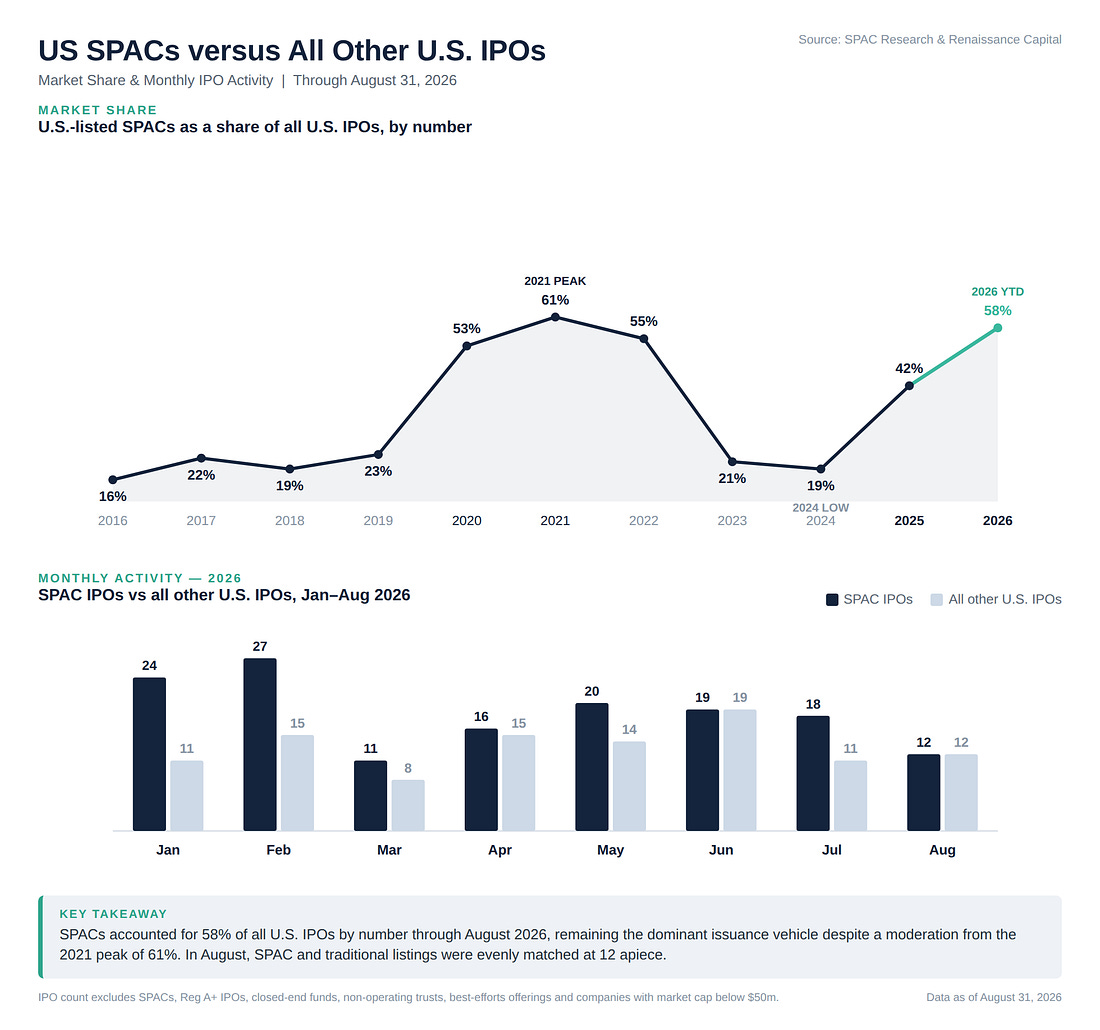
- Market share held near a cycle high. SPACs represented 58% of U.S. IPOs by count in 2026 year-to-date, up from 42% in 2025 and 19% in 2024, and still within reach of the 61% record set in 2021. In August, SPAC and traditional listings drew level at 12 apiece.
- Issuance normalised into late summer. August delivered 12 SPAC IPOs raising $1.8 billion, alongside 18 fresh S-1 filings targeting $3.1 billion. Year-to-date, 147 SPAC IPOs have priced for $29 billion, already surpassing 2025's full-year count of 144.
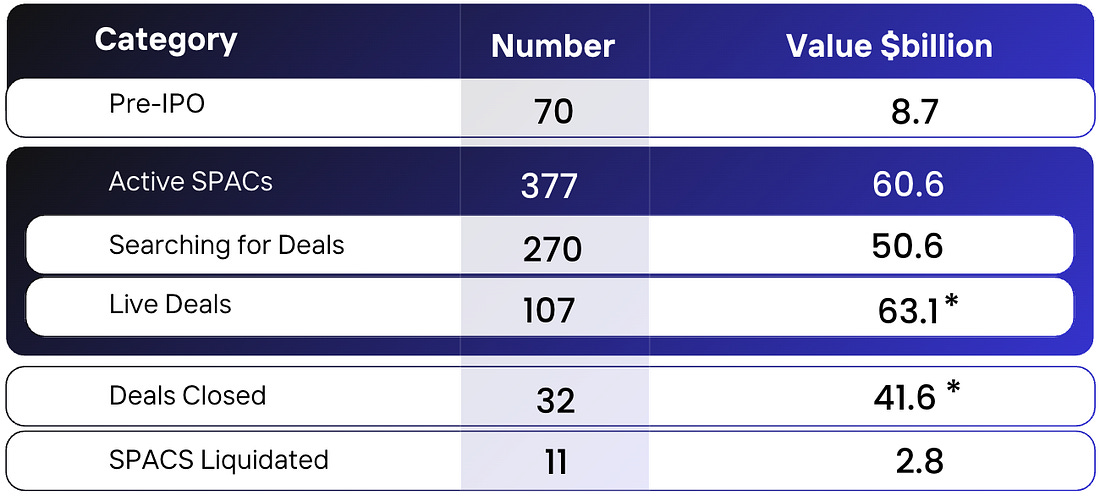
- The pipeline remains the deepest since 2021. The forward book holds 70 pre-IPO vehicles seeking $8.7 billion, 377 active SPACs with $60.6 billion in trust, and 107 announced live deals carrying $63.1 billion in equity value.
- Listings stayed structurally tilted to SPACs. Blank-check vehicles out-issued traditional IPOs in six of the year's eight months and matched them in June and August. Even as the monthly cadence cooled into the summer, the SPAC remained the primary route to U.S. public markets this cycle, not a periodic complement.
Fundraising in the USA
Private Markets
- The liquidity problem is now a distribution problem. 2026 midyear came out to be a triple shock braking private equity's recovery: an AI-driven repricing of software assets, redemption stress in private credit, and the energy spike tied to the Iran conflict. With roughly 33,000 unsold portfolio companies and an average holding period stretched to seven years, the constraint on new commitments is less about appetite than about capital that has yet to be returned.
- Software marks led the repricing. PE-held software valuations fell about 8% overall, with U.S. marks down 8.9% against 4.2% in Europe, as the assumptions underwriting a decade of technology buyouts were re-examined against the economics of AI.
- Deal and exit activity normalised from a strong 2025. First-quarter transaction value ran at $481.6 billion across roughly 5,100 deals, with 975 exits worth $306.7 billion, healthy in absolute terms but softer sequentially. Fundraising was broadly flat year-over-year at $86 billion for the quarter, extending the most difficult capital-raising environment since 2018.
- Dry powder remains the offsetting force. With close to $2 trillion in committed but undeployed capital and investment periods advancing, managers face growing pressure to deploy, pointing to larger average check sizes and selective competition for the highest-quality assets even as the broader fundraising market stays tight.
Public Markets
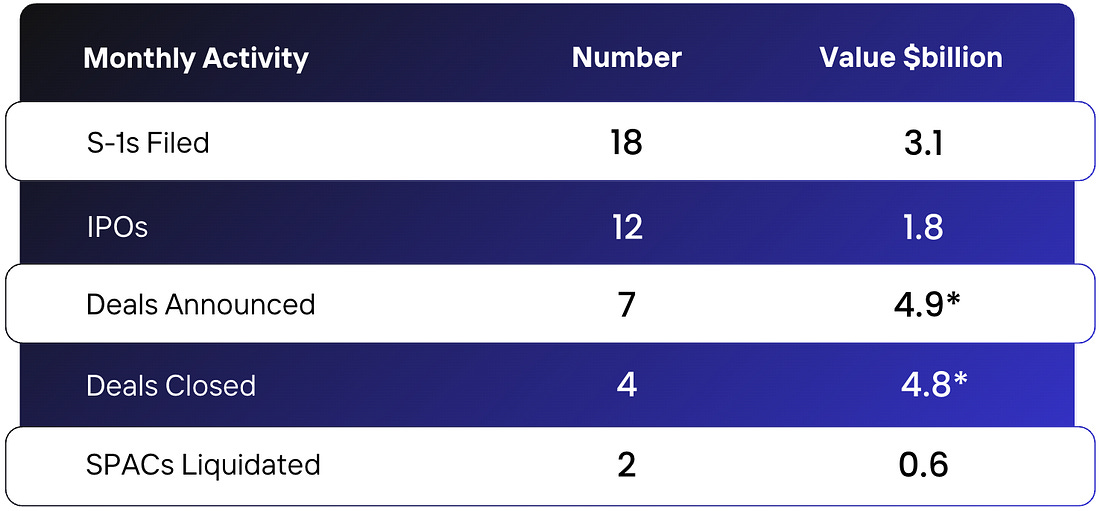
- Issuance momentum cooled but held. August produced 12 SPAC IPOs for $1.8 billion and 18 new S-1 filings for $3.1 billion. Year-to-date, 147 SPACs have priced for $29 billion, with a further 70 pre-IPO vehicles in registration seeking $8.7 billion.
- Combinations kept converting. Sponsors announced 7 deals in August worth $4.9 billion in equity value and closed 4 for $4.8 billion, against 2 liquidations ($0.6 billion). Year-to-date, 32 combinations have closed for $41.6 billion versus 11 wind-downs returning $2.8 billion.
- Trust capital still underwrites a multi-year runway. The ecosystem spans 377 active SPACs holding $60.6 billion, of which 270 are still searching ($50.6 billion) and 107 carry announced deals worth $63.1 billion in equity value, one of the deepest committed-capital pools since 2021.
SPAC Issuance Activity (August 2026)
- August issuance stepped down without stalling. 12 SPACs priced for $1.8 billion, below July's 18 and the first-quarter surge, but still comfortably above the 2023-2024 trough, when annual issuance fell to 31 and 57 IPOs respectively. Eighteen fresh S-1 filings for $3.1 billion replenished the queue, holding the pre-IPO pipeline at 70 vehicles and $8.7 billion.
- Conversion remained the through-line. Sponsors closed four combinations worth $4.8 billion in equity value during the month against two liquidations, extending a year-to-date tally of 32 closings for $41.6 billion versus 11 wind-downs returning $2.8 billion. Closed value now exceeds liquidated trust capital by nearly fifteen times, evidence that sponsors continue to execute deals rather than return capital to shareholders.
- The forward book is still both constraint and opportunity. With 107 announced live deals carrying $63.1 billion in equity value, the pending pipeline dwarfs what has closed year-to-date and points to a heavy completion calendar into 2027 as trust deadlines approach. If completion rates hold, the coming quarters should convert a substantial share of the 270 vehicles still searching for targets into newly public operating companies.
Recent De-SPACs Closed
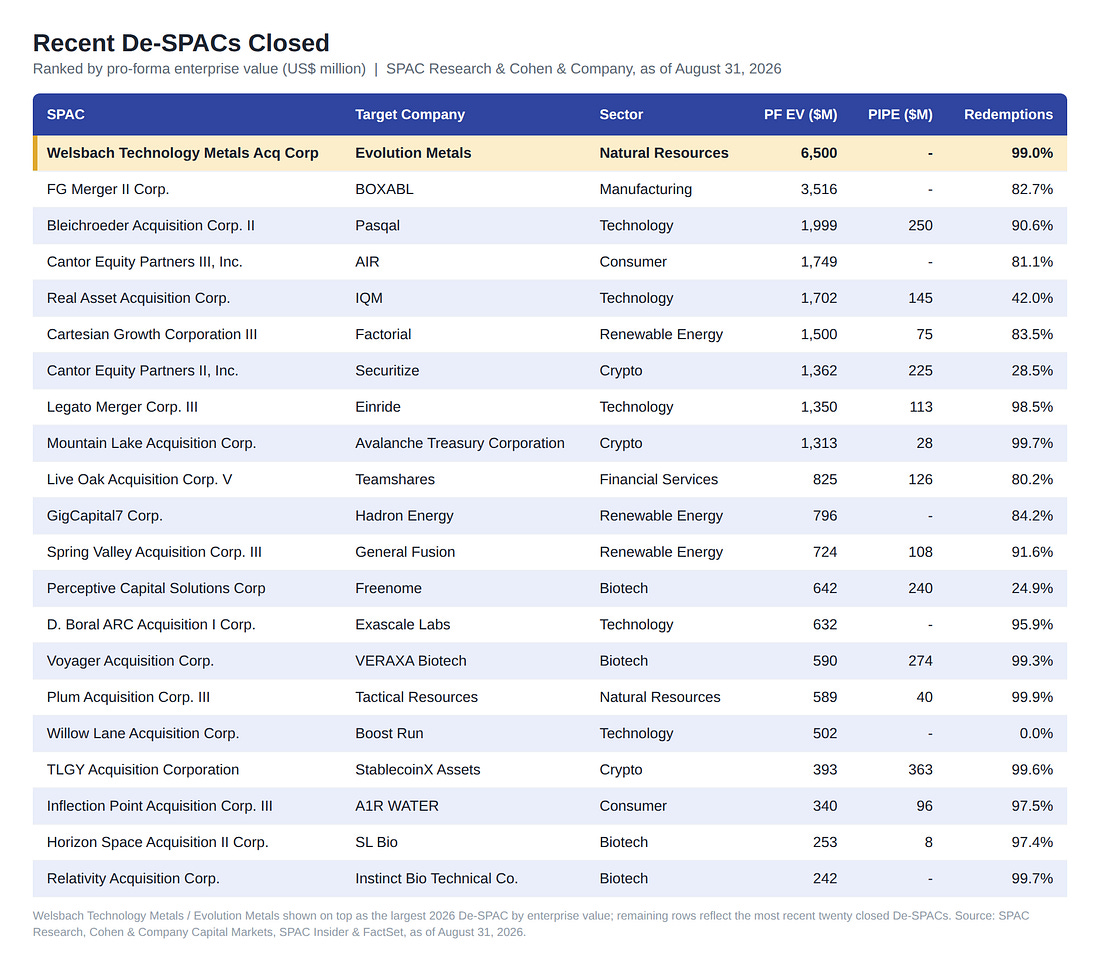
Welsbach Technology Metals Acq Corp and Evolution Metals remains the largest De-SPAC merger consummated in 2026, at a $6.5 billion enterprise value, and continues to anchor the closed cohort.
- Sector mix stays tilted to frontier technology, biotech and crypto. Technology accounts for five of the most recent twenty closings, biotech four, and crypto and renewable energy three each. The two largest, FG Merger II/BOXABL at $3.5 billion and Bleichroeder/Pasqal at $2.0 billion, span modular construction and quantum computing, a reminder that scale is no longer confined to a single theme.
- Redemptions remain the defining risk. Sixteen of the twenty deals closed with redemptions above 80%, and the recent-20 median sits at 91.1%. High redemptions strip trust cash at close, shifting the funding burden onto PIPE and alternative financing and pressuring post-deal balance sheets.
- PIPE support is selective, not systematic. Six of the twenty closed with no PIPE at all. Where sponsors secured commitments, size ranged from $8 million at Horizon Space/SL Bio to $363 million at TLGY/StablecoinX, showing institutional capital concentrating behind specific names rather than the asset class as a whole.
- Deal sizes stay bifurcated. Pro-forma enterprise values span $242 million to $3.5 billion, with a recent-20 mean of $1.05 billion against a median of $760 million, a barbell distribution pulled upward by a handful of large quantum, crypto and industrial transactions.
- Post-close performance separates quality. Outcomes diverge sharply: Boost Run, which closed with 0% redemptions, trades near $17, while several near-fully-redeemed deals trade below $1, including VERAXA Biotech at $0.72 and Instinct Bio at $0.42. Low redemptions and committed PIPE are increasingly the best predictors of aftermarket survival.
Heatmap: Growing Sectors and Geographies
Growing Sectors in SPACs
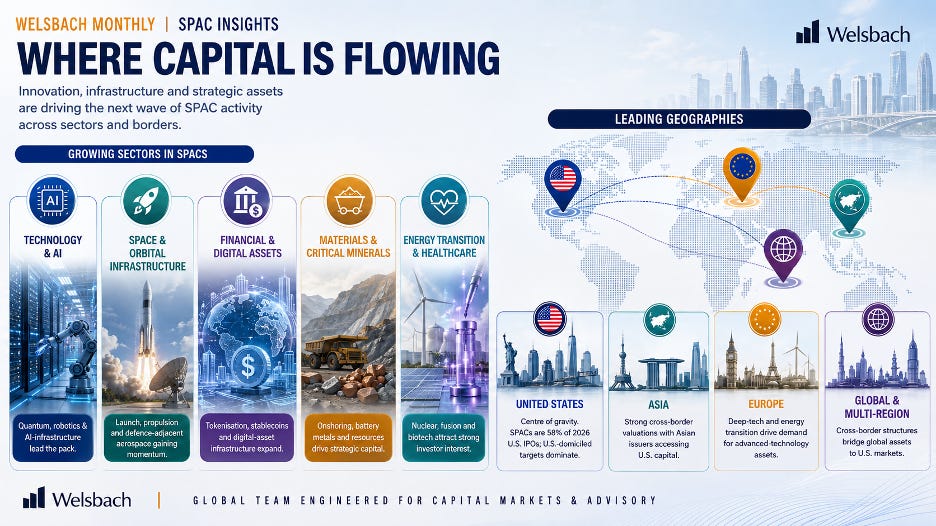
- Technology and AI still lead both live and closed cohorts. Silicon Valley/EigenQ ($3.0 billion) and Apex Treasury/TECfusions ($4.2 billion) headline the announced book, Churchill Capital XI/Agility Robotics tops live deals at $2.5 billion, and recent closings include Pasqal ($2.0 billion), IQM ($1.7 billion) and Einride ($1.4 billion). Quantum computing, robotics and AI-data-centre infrastructure anchor the theme.
- Space and orbital infrastructure has emerged as a distinct cluster. Bleichroeder III/Ursa Major ($2.3 billion), Black Spade III/Astrum Space ($1.0 billion), Columbus Circle II/Elroy Air ($961 million) and Pono Capital Four/Blackstar Orbital ($380 million) reflect sponsors moving into launch, propulsion and defence-adjacent aerospace.
- Financial and digital-asset infrastructure keeps broadening. Live deals feature Super Apps Holdings ($813 million) and Leading Group ($573 million); closings include Securitize ($1.4 billion), StablecoinX ($393 million) and Avalanche Treasury ($1.3 billion). Tokenisation, stablecoins and digital-asset treasuries are displacing speculative crypto exposure.
- Materials, critical minerals and energy transition round out the leaders. Constellation/US Elemental ($586 million), Pyrophyte/Sio Silica ($758 million) and Kensington VI/Nth Cycle ($585 million) reflect onshoring and battery-metals demand, while ClimateRock/GreenRock ($475 million) and the closed General Fusion ($724 million) carry the nuclear and fusion theme. In healthcare, RF Acquisition II/Nanyang Biologics leads live common stock at $43.00, with Oak Hill Bio at $22.00.
Leading Geographies
- United States, the centre of gravity. SPACs are 58% of 2026 U.S. IPOs, and U.S.-domiciled targets dominate the closed cohort, with Boost Run, Freenome, IQM, Presidio Petroleum and Horizon Quantum all listing stateside.
- Asia, the strongest cross-border valuations. RF Acquisition II/Nanyang Biologics (the top-priced live common at $43.00), Super Apps Holdings ($813 million) and Leading Group ($573 million) reflect Asian issuers seeking U.S. institutional capital and deeper public-market liquidity.
- Europe, deep-tech and energy transition. Alpha Star/XDATA ($180 million, financial), ClimateRock/GreenRock ($475 million, energy) and Cartesian II/InoBat (renewable), alongside the European-domiciled Pasqal closing, sustain demand for nuclear, electrification and advanced-technology assets.
- Global and multi-region structures. Research Alliance III/Oak Hill Bio ($353 million, healthcare), Pyrophyte/Sio Silica ($758 million, materials) and Real Asset/IQM ($1.7 billion, technology) continue to bridge cross-border assets to U.S. markets.
From Research to Execution
Whether you're evaluating an investment, preparing for a transaction, conducting due diligence, or building materials for a client, it helps reduce the manual work involved in finding, validating, analyzing, and organizing financial information.
Brexy: The AI Operating System for Capital Markets
Brexy is an AI platform for capital markets that brings financial research, company data, documents, models, and institutional knowledge into one secure workspace.
Built for investment bankers, investors, deal teams, and financial advisors, Brexy helps teams research companies, analyze financial information, perform due diligence, build financial models, create investment materials, and move from analysis to execution faster.
One secure, finance-native environment. Less searching. Less switching. More work getting done.
A Good Read: Capital Markets Reimagined
If you're interested in how AI is reshaping investment banking, private markets, capital markets and institutional finance, this is a good one to read. Welsbach Co-Founder Sankalp Shangari turns from where the markets are to the institutions that operate them, and asks how the arrival of artificial intelligence could reshape the workflows, expertise and decision-making infrastructure of investment banking, private markets, capital markets and institutional finance.
Check out his latest Chapter 3, "The $10 Million Banker and the Age of Machines," and subscribe to Capital Markets Reimagined for future insights and updates.
Read Chapter 3: The $10 Million Banker and the Age of Machines
Subscribe to Capital Markets Reimagined
Conclusion
August confirmed the pattern rather than breaking it. Traditional and SPAC listings drew level for the month, but with SPACs still 58% of 2026 issuance, 147 IPOs priced year-to-date and a live-deal book worth $63.1 billion, the blank-check vehicle remains the dominant route to U.S. public markets. Conversion is now outpacing attrition decisively, 32 combinations closed against 11 liquidations, with closed value exceeding returned trust capital by nearly fifteen to one, even as redemptions above 90% keep the funding burden on PIPE and alternative financing. Into a data-dependent Fed and a heavier 2026-2027 completion calendar, execution quality, not access to the market, will remain the differentiator.
Download
Take this edition with you
Register once to download this Welsbach Monthly edition as a branded PDF, including all charts and exhibits.