
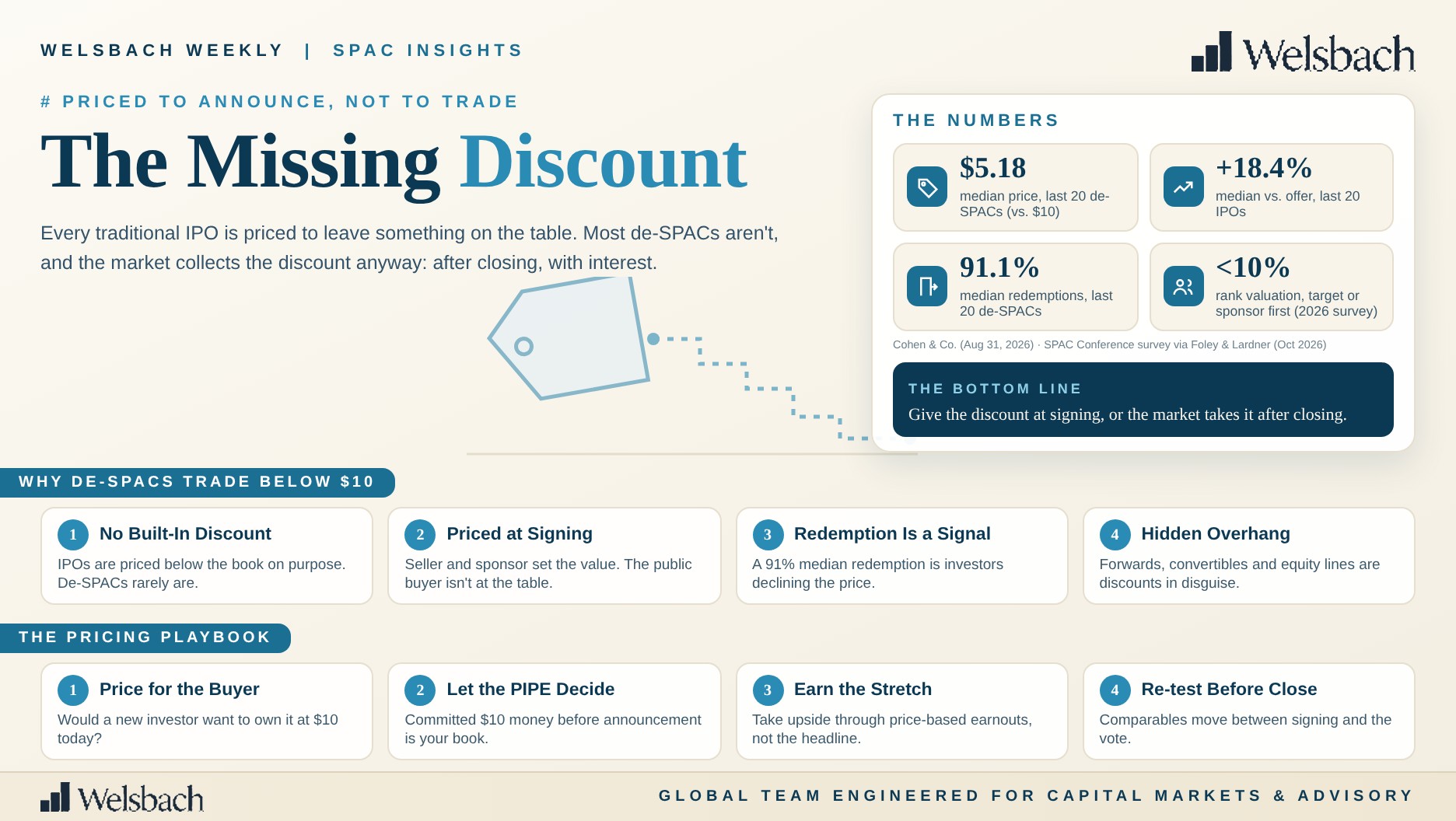
Every traditional IPO is priced to leave something on the table. Most de-SPACs aren't, and the market collects the discount anyway, after closing, with interest.
Originally published on Welsbach SPACtacular Insights (Substack)
| The Numbers | Value |
|---|---|
| Median price, last 20 de-SPACs (vs. $10) | $5.18 |
| Median vs. offer, last 20 IPOs | +18.4% |
| Median redemptions, last 20 de-SPACs | 91.1% |
| Rank valuation, target or sponsor first (2026 survey) | <10% |
| The bottom line | Give the discount at signing, or the market takes it after closing. |
Founders naturally gravitate towards the highest possible valuation, but the headline figure does not always translate into the best long-term outcome. Drawing on industry data, this article examines the trade-offs behind valuation expectations and highlights the importance of comparable transactions, PIPE price discovery and earnout structuring in determining a credible and sustainable market valuation. It underscores the value of independent, data-driven assessment in helping founders understand what their business can realistically command in the public markets before committing to a transaction.
At this year's SPAC Conference, attendees were asked to name the industry's biggest challenge. Every one of them gave the same answer: post-merger trading. Majority said they were unhappy with recent de-SPAC results.
Then they were asked what matters most when judging a deal. Most of them said PIPE terms. Fewer than one in ten pointed to target quality, valuation or sponsor experience.
Read those two answers together. The industry agrees the share price is the problem, and almost nobody is looking hard at the price the deal is struck at. That gap is the subject of this week's issue.
Everyone Agrees on the Problem
The numbers behind the frustration are not subtle. As of the end of August, the last 20 closed de-SPACs traded at a median of $5.18 a share, measured against the $10 at which each deal was struck. In the same report, on the same date, the last 20 traditional IPOs traded at a median 18.4% above their offer price.
Same market, same month, same investors. One route is roughly half underwater; the other is in the money.
This is not a 2026 accident. SPAC-merged companies from the 2020-21 vintage were down more than 60% on average from $10 by December 2022, against a 36% decline for traditional IPOs of the same vintage. By mid-2024, roughly 85% of the 300 or so companies that completed SPAC mergers through 2022 were trading below their listing price. The pattern repeats because the cause repeats.
Half of Ten Dollars
Why should a founder care about the aftermarket once the deal has closed? Because after closing, the share price stops being a scoreboard and becomes the company's currency.
Every follow-on raise is priced off it. Every acquisition paid in stock is priced off it. Employee equity, research coverage, index eligibility and the next institutional conversation all start from the number on the screen, not the number in the merger agreement. The founder's own rollover equity is marked at the market too.
A company that lists at a $10 reference and trades at $5 has not just disappointed investors. It has halved the purchasing power of its own stock at the moment it most needs capital, and every raise after that dilutes harder than the one before.
Priced to Announce, Not to Trade
Here is the mechanism most founders never see.
A traditional IPO is priced through a book. Bankers take orders from many investors and then, deliberately, set the price below what that book suggests the company is worth. That built-in discount is the reward for the buyer who takes the risk on a new stock, and it is why a well-run IPO tends to trade up rather than down. The issuer leaves money on the table on purpose, because a stock that trades well is worth more over time than a few extra points at pricing.
A de-SPAC has no book and usually no discount. The value is negotiated at signing between the target and the sponsor, at $10 a share, and the headline number often reflects what the seller wants and what makes the sponsor's economics work. The person who actually has to buy the stock, the public investor, is not at the table.
So the public investor answers in the only way available: by redeeming. The last 20 de-SPACs saw a median 91.1% of their trust redeemed. Some of that is arbitrage funds that redeem by default, but not all of it. When holders like the price, they stay. Boost Run closed with zero redemptions and traded above $17 at the end of August; Freenome closed with 24.9% and traded near $15. Redemption is a price signal, and in most deals the signal is unambiguous.
Then the aftermarket finishes the job. The discount the deal declined to offer is taken anyway, usually deeper than an IPO book would ever have asked for. Overhang makes it worse: prepaid forwards, convertibles and equity lines are discounts in disguise, sold to the investors who rescued the closing and paid for by everyone holding the stock afterwards.
To be fair, the traditional route is no free lunch this year. PwC puts the average 2026 IPO only about 2% above its offer price through September, and the two largest third-quarter IPOs trade 25-27% below theirs. That is the point. The rule is the same for everyone, overprice and the market takes it back. Only one process is built to leave a discount on purpose.
The Pricing Playbook: Leave Something on the Table
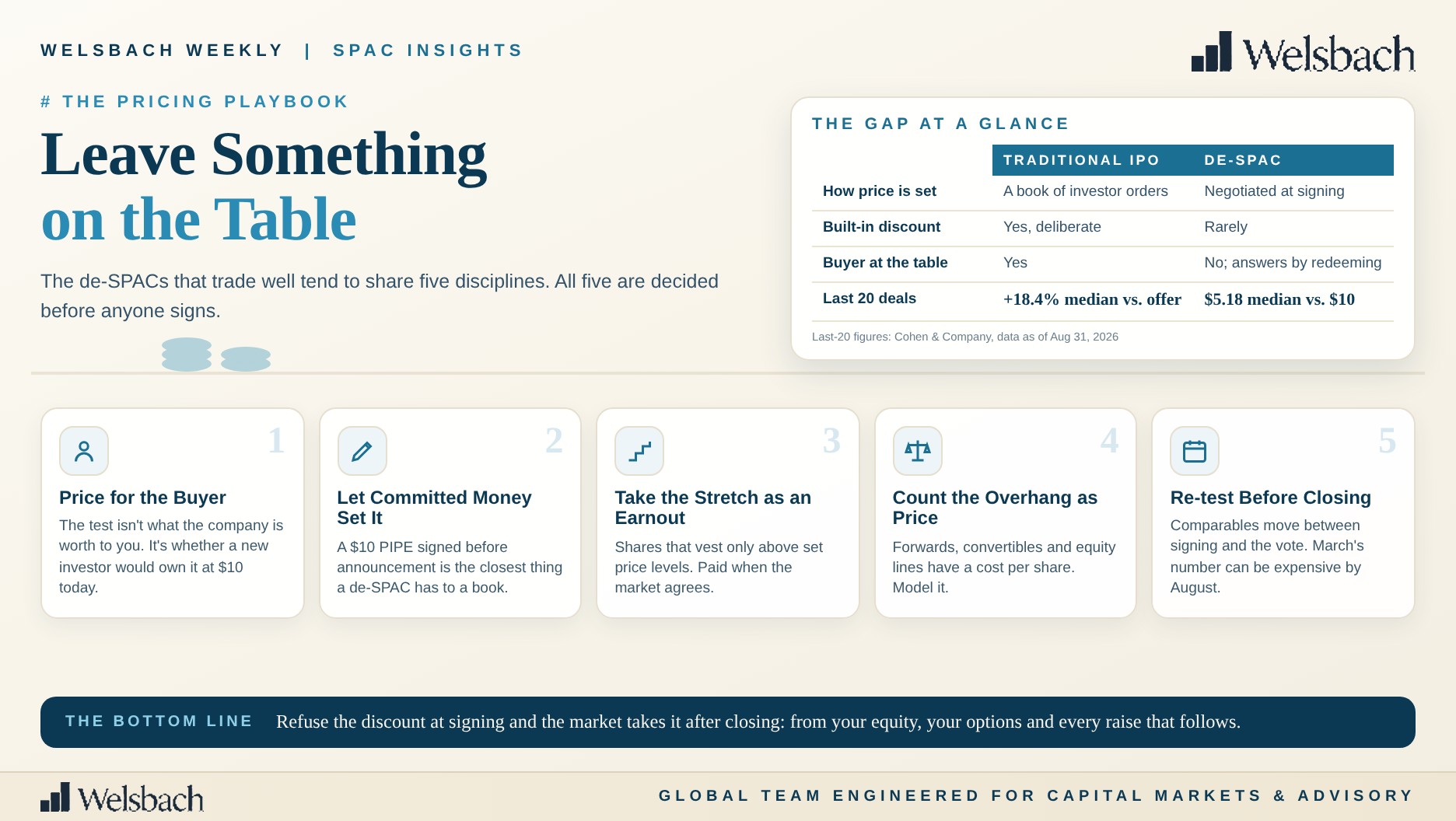
| Traditional IPO | De-SPAC | |
|---|---|---|
| How price is set | A book of investor orders | Negotiated at signing |
| Built-in discount | Yes, deliberate | Rarely |
| Buyer at the table | Yes | No; answers by redeeming |
| Last 20 deals | +18.4% median vs. offer | $5.18 median vs. $10 |
The de-SPACs that trade well tend to share a handful of disciplines.
- They price for the buyer, not the seller. The test is not "what is the company worth to us?" It is "would a new investor want to own this at $10 today?" If the honest answer is no, the headline is too high.
- They let committed money set the number. A PIPE priced at $10 and signed before announcement is the closest thing a de-SPAC has to a book. If specialist investors will not write the cheque at your valuation, the market has given you its answer before you go public.
- They take the stretch as an earnout. If you believe the company is worth more, structure the difference as shares that vest only when the stock trades above set price levels. You get paid for the upside the moment the market agrees with you, and not before.
- They count the overhang as price. Every forward, convertible or equity line has a cost per share. Model it as part of the valuation, not as a financing footnote.
- They re-test before closing. Comparables move in the months between signing and the vote. A number that was defensible in March can be expensive by August.
The Number That Has to Survive
On one side sits a founder who has spent years building a company and naturally wants the biggest number for it. On the other sits a public market that will reprice that number within weeks of listing. Between them is a negotiation in which the buyer whose opinion matters most is not in the room.
That is the gap Welsbach works in. For companies valued from roughly $150 million to $4 billion, our job is to set a valuation that survives contact with the aftermarket: benchmarking against traded comparables, using PIPE conversations as price discovery before anything is announced, designing earnouts so the stretch is paid for by performance rather than promised at signing, and matching companies with sponsors who care how the stock trades on day 90, not just on closing day. Standing in the middle of the deal, the number we are working towards is the one that still holds up after the market has had its say.
The Market Always Collects
The discount is not optional. Every new stock has to offer the buyer a reason to own it, and the only choice a founder makes is when and to whom that discount is given.
Give it at signing, to committed investors who then support the stock, and the company lists with a currency it can use. Refuse it, and the market takes it after closing, from the founder's equity, the employees' options and every raise that follows.
With 153 SPAC IPOs already priced this year, vehicles are not scarce. Stocks that trade well after listing are. The companies that end up with them will be the ones that left something on the table on purpose.
Need Comps Before a Call? Building a Buyer List? Reviewing a CIM?
This time, we have something new to share: Brexy Agent Studio is live, and your first month is free.
You can put AI agent teams to work on the first pass, so you spend less time gathering information and more time on the work that needs your judgment. Inside the studio, you'll find specialist teams for financial analysis and valuation, research and market intelligence, M&A, and coverage and origination. And that's just the start.
You can explore more teams in the studio and create your own agent teams based on your workflows and requirements. Whether you want help with a specific task or want to build a team around the way you work, you can shape Brexy to fit your needs.
You may explore the studio, and see what you can put to work.
Exploring growth capital or a U.S. listing? Partner with the Welsbach team to make it happen. Email contact@welsbach.sg or reach us through the contact page.
Download
Take this edition with you
Register once to download this Welsbach Weekly edition as a branded PDF, including all charts and exhibits.