
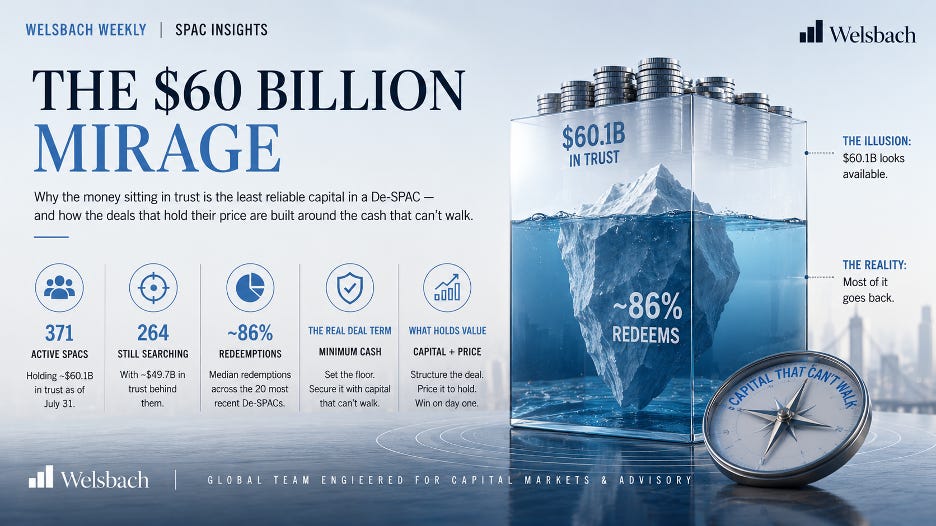
Why the money sitting in trust is the least reliable capital in a De-SPAC, and how the deals that hold their price are built around the cash that can't walk.
Originally published on Welsbach SPACtacular Insights (Substack)
Here is a number that looks like good news. As of 31 July there were 371 active SPACs holding roughly $60.1 billion in trust, with 264 of them still hunting for a target and about $49.7 billion behind those (SPAC Research). For a growth company weighing a Nasdaq listing, that reads like an ocean of capital waiting to be deployed.
It isn't. Most of that money is going home.
Across the twenty most recently closed De-SPACs, a median of roughly 86% of public shareholders redeemed at the vote, they took their $10 back rather than stay in the combined company. So the trust is not a balance a target can count on. It is an option the trust's own shareholders hold against you, and in 2026 they exercise it almost every time. The $60 billion is real. The claim that it is available is the mirage.
What changed
For most of the market's history, the trust was the deal. A SPAC raised cash, held it, and delivered it to the target at closing. Redemptions existed but were the exception.
That relationship has inverted. Redemptions are now the base case, and at extreme levels: the six deals that closed in July ran a median near 62%, and the broader run of recent closings sits far higher. A founder who sizes a transaction against the trust is budgeting off a number that, statistically, will be gutted by the time the cash actually changes hands.
The market has responded by building a second layer of capital that public shareholders cannot vote away. Cohen tracks it under a single heading, "alternative financing," which it defines as structured and equity-like commitments such as forward purchase agreements, equity lines of credit and non-redemption agreements, sitting alongside the more familiar committed PIPE. This is the machinery that has grown up precisely because the trust became unreliable. It exists to manufacture certainty where the trust no longer provides it.
Why it matters
Once you accept that the trust is optional money, one deal term stops being boilerplate and becomes the whole negotiation: the minimum cash condition.
Minimum cash is the floor of capital the combined company must have at closing, trust proceeds that survive redemptions, plus PIPE, plus any alternative financing, below which the deal either breaks or has to be renegotiated. It is the number that decides two things at once: whether the transaction closes at all, and how the stock trades on day one. A company that sets a realistic floor and fills it with capital that can't redeem walks into the public market funded. A company that leaves the floor to be met by the trust is gambling the entire transaction on shareholders it does not control.
The July tape shows the split cleanly. Freenome closed with about 25% redemptions and a $240 million PIPE, and trades near $11. IQM, the quantum-computing business, closed with 42% redemptions and a $145 million PIPE, and trades near $10. Securitize came with a $225 million PIPE and roughly $50 million of additional structured financing, and cleared with 28% redemptions. Even General Fusion, which lost more than 90% of its trust to redemptions, held near $10 because a $108 million PIPE stood behind it. The trust cratered; the deal didn't, because the deal wasn't relying on the trust.
The real problem
The mirage is only half the trap. The other half is assuming that committed capital, by itself, buys a good outcome. It doesn't.
Two of July's larger deals carried substantial PIPEs and still broke. VERAXA Biotech closed with a $274 million PIPE and 99% redemptions and trades around $0.30. StablecoinX raised a PIPE close to $900 million, saw 99.6% redemptions, and sits near $1.57. Large checks did not rescue either one.
The lesson is uncomfortable but important. Committed capital is necessary; it is not sufficient. When nearly every public shareholder redeems, the remaining float is thin and fragile, and if the valuation was stretched to begin with, a big PIPE simply cushions a long fall rather than preventing it. Capital structure and price have to be built together. A cash floor set against an honest valuation holds. The same floor set against a number the market won't defend just delays the repricing.
The question is not "how much can we raise," but "how much do we actually need, from money that can't leave, at a price the market will hold."
Those are three separate questions, and most first-time issuers treat them as one.
What smart companies are doing differently
They start from the floor, not the ceiling. Before negotiating headline valuation, they decide the minimum cash the business genuinely needs to execute its plan for the next 18 to 24 months, and they treat that as the number the deal must clear.
Then they fill it with capital that survives the vote. In practice that means a committed PIPE anchored by institutions that have done real work on the story, reinforced where needed by non-redemption agreements with existing holders and, in tighter deals, forward purchase agreements or a backstop. The trust becomes upside, not the plan.
And they price to hold. A slightly lower entry valuation that the aftermarket defends is worth far more than a headline number that unwinds in the first month, because the second listing, the follow-on, the acquisition currency, the credibility with the next investor, depends on the first one holding.
- The trust is not your money. Assume the majority redeems and build as if it will.
- Minimum cash is the real deal term. Set it to what the business needs, secure it with capital that can't walk, and negotiate it early rather than discovering it at the vote.
- A big check against a bad price still breaks. Structure and valuation are one decision, not two.
Where Welsbach fits
At the heart of every one of these transactions is a growth company that knows its business inside out. On the other side is the U.S. capital-markets ecosystem, SPAC sponsors, PIPE and institutional investors, underwriters, securities lawyers and the exchange. The challenge is not whether the company is ready. It is making sure the capital structure is built around the amount of money that will actually be available at closing, rather than what the company expects a SPAC to bring.
That is where Welsbach comes in, not as a broker, but as a structuring partner. The focus is on helping founders establish a realistic minimum-cash requirement, plan any pre-IPO bridge financing, and structure the PIPE and other financing around a valuation that can hold up in the public market. Just as importantly, Welsbach connects companies with the institutional and PIPE investors needed to turn that financing plan into committed capital.
For the cross-border companies Welsbach works with across Asia, the Gulf and Europe, there is another important part of the job: translating a company's growth story and financial plan into something U.S. investors can underwrite with confidence. With a team that includes alumni of Goldman Sachs, J.P. Morgan, Deutsche Bank and Macquarie, and more than $20 billion in transaction value across 15 mandates, including Evolution Metals (Nasdaq: EMAT), Welsbach's role is ultimately to ensure that the capital presented at the signing is the capital that remains available through closing.
Finding a company with a SPAC is relatively easy when 264 SPACs are actively looking for targets. The harder and often less visible job is making sure the transaction is backed by capital that is committed, credible and there when it matters.
From Information to Action
Modern finance teams don't have an information problem. They have a workflow problem.
Research sits in reports. Financial data lives across multiple platforms. Deal documents sit in data rooms. Company knowledge is spread across emails, shared drives, and internal systems. The real challenge is bringing all of that context together, finding what matters, and turning it into work that moves a deal or investment forward.
That's What Brexy is Built For
Brexy is a purpose-built AI platform for capital markets, designed by people who understand how financial workflows actually work. It connects to the data and systems financial teams already rely on and helps dealmakers, investors, bankers, and advisors research, analyze, model, conduct diligence, generate investment materials, and execute workflows all within one secure, finance-native environment.
Instead of another AI chatbot that simply answers questions, Brexy is designed to understand financial context and execute the work.
If your team is spending too much time moving between documents, data rooms, research platforms, models, and internal knowledge, Brexy is worth exploring.
Learn more at brexy.ai or book a demo.
Conclusion
The $60 billion in trust is the most-quoted number in the market, but it is also one of the least useful. What determines whether a company lists with adequate funding and trades where it should is a smaller figure that it can engineer for itself: the amount of cash it has secured before shareholders vote.
Four SPAC deals were terminated in July, representing a combined $2.2 billion in enterprise value. None failed because there was a lack of trust capital in the market. They failed because the capital that mattered had not been secured.
The companies that get this right may appear, on paper, to have raised less. In reality, they will have raised the money that was actually committed and available when it mattered.
Exploring growth capital or a U.S. listing? Partner with the Welsbach team to make it happen. Email contact@welsbach.sg or reach us through the contact page.
Download
Take this edition with you
Register once to download this Welsbach Weekly edition as a branded PDF, including all charts and exhibits.