
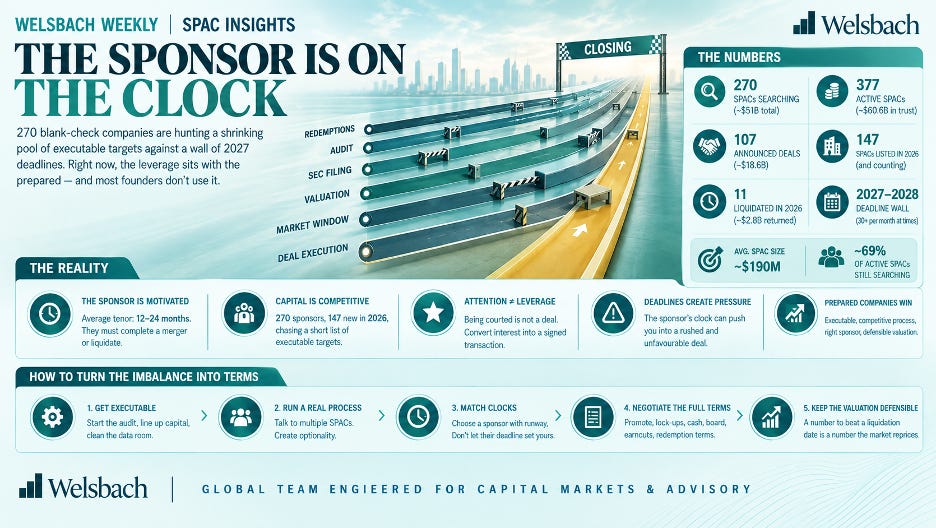
270 blank-check companies are hunting a shrinking pool of executable targets against a wall of 2027 deadlines. Right now the leverage sits with the prepared, and most founders don't use it.
Originally published on Welsbach SPACtacular Insights (Substack)
For most of the last decade, the founder walked into a SPAC negotiation as the supplicant. The sponsor had the listed vehicle, the trust, the relationships and the leverage. The target had a pitch and a hope.
That has quietly reversed. At the end of August, 270 SPACs were still searching for a company to merge with, sitting on roughly $51 billion they must either deploy or hand back. The average one holds close to $190 million and a countdown clock. There are not 270 executable growth companies waiting to be found. For the prepared company, that imbalance is the most leverage it has ever had at the table.
Now It's Their Clock
There are 377 active SPACs holding about $60.6 billion in trust. Only 107 have found a partner. The other 270 are hunting, and every one of them is a wasting asset.
A SPAC is not patient capital. Each has a tenor, typically 12 to 24 months, after which it must complete a merger or liquidate, return the trust, and hand its sponsor a total loss on millions of dollars of at-risk capital and two years of work. Eleven SPACs have already liquidated in 2026, returning $2.8 billion to shareholders and nothing to their sponsors. A wall of deadlines builds through 2027 and into 2028; in some single months, more than thirty vehicles hit their expiry at once.
And the supply keeps growing. Roughly 147 SPACs have gone public in 2026 alone, pouring more vehicles into the same hunt while the number of companies that can actually survive a listing has not moved. Nearly seven in ten active SPACs are still without a partner. That is not a shortage of capital chasing a shortage of capital, it is a glut of capital chasing a shortage of executable targets.
So the motivated party has changed. The sponsor with nine months left and $200 million to place needs a deal far more than any one good company needs that sponsor. The clock is theirs now, not yours.
Attention Is Not Leverage
You can see the imbalance in how sponsors behave around scarce targets. In August, they announced a cluster of space deals within days of each other, Astrum Space, Ursa Major Technologies, alongside robotics, quantum and critical-minerals combinations. Well-known sponsors are chasing the same short list of strategic-technology names. A marquee vehicle like Churchill Capital Corp XI announced a $2.5 billion combination with Agility Robotics; the space, quantum and defense names draw the same brand-name interest. A genuinely scarce company gets courted hard, and it is easy to read that attention as strength.
Here is where founders go wrong. They confuse being courted with holding the cards. A sponsor calling you is interest, not leverage. You hold leverage only if you can actually close, audit underway, committed capital identified, a data room that survives diligence, a story that holds up. The moment diligence starts, an unprepared target watches the power reverse: the sponsor's interest cools, the terms tighten, and the company that thought it was being chased is suddenly the one persuading. Attention you cannot convert is not leverage.
The Deadline Trap
The sponsor's clock cuts both ways, and this is the part that catches good companies.
The same deadline that hands you leverage at the table also creates a trap. A sponsor six months from liquidation wants a signature quickly, and a fast signature is not a good deal. Founders get pulled onto the sponsor's timeline. They accept a stretched valuation to make the arithmetic work before the deadline. They skip a competitive process because this one is "ready now." They take a vehicle whose clock is shorter than their own path to a registration statement.
That is how a company rushes an unfinished transaction into the announce-to-close gap, the stretch where, as we wrote last week, deals now fail most often. The deadline that pressured the sponsor becomes the deadline that breaks the target, and the company that had leverage in the first meeting is trading at cents on the dollar on its first day. Leverage misused becomes leverage reversed.
How the Prepared Press the Advantage
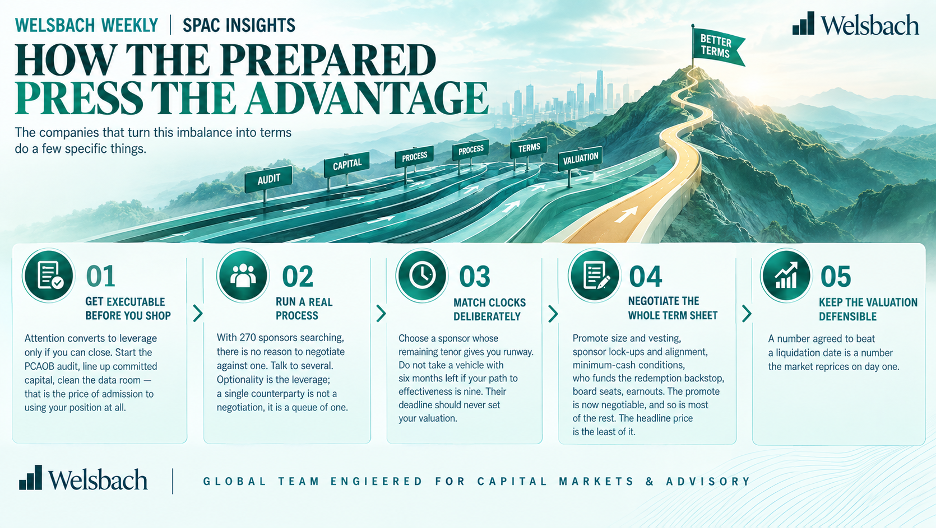
- They get executable before they shop. Attention converts to leverage only if you can close. Start the PCAOB audit, line up committed capital, clean the data room, that is the price of admission to using your position at all.
- They run a real process. With 270 sponsors searching, there is no reason to negotiate against one. Talk to several. Optionality is the leverage; a single counterparty is not a negotiation, it is a queue of one.
- They match clocks deliberately. Choose a sponsor whose remaining tenor gives you runway. Do not take a vehicle with six months left if your path to effectiveness is nine. Their deadline should never set your valuation.
- They negotiate the whole term sheet. Promote size and vesting, sponsor lock-ups and alignment, minimum-cash conditions, who funds the redemption backstop, board seats, earnouts. The promote is now negotiable, and so is most of the rest. The headline price is the least of it.
- They keep the valuation defensible. A number agreed to beat a liquidation date is a number the market reprices on day one.
Running the Table
On one side is an international growth company with genuine scarcity value, differentiated technology, exposure to a strategic sector, and a proposition that resonates with U.S. capital markets. On the other are approximately 270 SPAC sponsors operating against a finite clock, competing for a limited pool of credible targets. In between lies a negotiation that most founders will navigate only once, against counterparties who execute these transactions repeatedly.
That intersection is where the work matters. Welsbach's Target-to-SPAC Matching platform is designed to convert this structural imbalance into negotiating leverage. We evaluate candidate SPACs across sponsor quality, sector alignment, transaction size, remaining tenor and structural considerations, identifying not simply which SPACs are available, but which provide the appropriate runway, alignment and execution certainty.
We then create a competitive process rather than allowing the company to become captive to the first interested sponsor, while ensuring the business is transaction-ready so that leverage is preserved when it matters most. Positioned at the centre of the transaction, our objective is straightforward: ensure that the party operating against the clock is the sponsor, not the company, and maintain that leverage through to signing.
From Research to Execution
Whether you're evaluating an investment, preparing for a transaction, conducting due diligence, or building materials for a client, it helps reduce the manual work involved in finding, validating, analyzing, and organizing financial information.
Brexy: The AI Operating System for Capital Markets
Brexy is an AI platform for capital markets that brings financial research, company data, documents, models, and institutional knowledge into one secure workspace. Brexy is now SOC 2 Type I compliant, a stronger foundation for the work that matters: secure, governed, auditable and built for finance.
Built for investment bankers, investors, deal teams, and financial advisors, Brexy helps teams research companies, analyze financial information, perform due diligence, build financial models, create investment materials, and move from analysis to execution faster.
One secure, finance-native environment. Less searching. Less switching. More work getting done.
A Good Read: Capital Markets Reimagined
If you're interested in how AI is reshaping investment banking, private markets, capital markets and institutional finance, this is a good one to read. Welsbach Co-Founder Sankalp Shangari turns from where the markets are to the institutions that operate them, and asks how the arrival of artificial intelligence could reshape the workflows, expertise and decision-making infrastructure of investment banking, private markets, capital markets and institutional finance.
Subscribe to Capital Markets Reimagined
Leverage Has an Expiry Date
This window exists because a wave of 2025 and 2026 issuance is now hunting into a strong tape with deadlines closing in. When those vehicles clear, through deals or through liquidations, the balance tilts back toward whoever holds the next scarce thing.
The founders who benefit are the ones ready to move while the sponsor is still the motivated party. That readiness is not built in the weeks after a SPAC calls; it is built in the months before, so that when the call comes the company can convert interest into terms rather than scramble to keep up. Being courted feels like power. It becomes power only when you can close, and only while the clock belongs to the other side of the table. Use it before it's yours.
Exploring growth capital or a U.S. listing? Partner with the Welsbach team to make it happen. Email contact@welsbach.sg or reach us through the contact page.
Download
Take this edition with you
Register once to download this Welsbach Weekly edition as a branded PDF, including all charts and exhibits.