
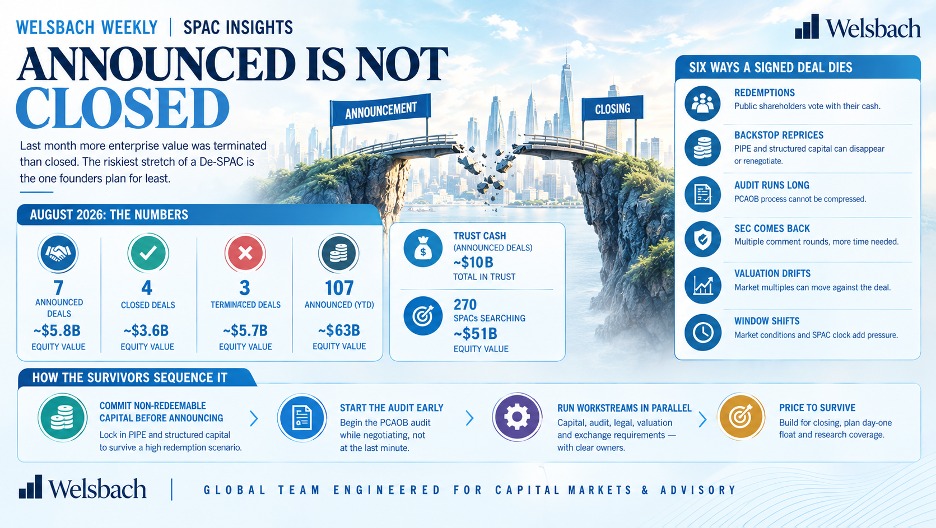
Last month more enterprise value was terminated than closed. The riskiest stretch of a De-SPAC is the one founders plan for least.
Originally published on Welsbach SPACtacular Insights (Substack)
In August, seven De-SPAC mergers were announced, carrying roughly $5.8 billion in combined enterprise value. Four closed, for about $3.6 billion, and three were terminated: signed deals, publicly announced, then called off, representing about $5.7 billion.
More enterprise value walked away from the altar last month than made it across. A year earlier, a single deal terminated for half a billion. The market did not slow down. It got more selective about which announcements actually become companies.
This is the part of the process that almost nobody plans for. Founders spend a year getting ready to sign. They spend far less energy on the six to nine months after they sign, which is now when deals are most likely to die.
Full Pipeline, Empty Finish Line
Supply is not the problem. As of the end of August, 107 mergers had been announced and were working toward a close, carrying about $63 billion in combined equity value. Another 270 SPACs were still searching, sitting on roughly $51 billion. There is more than enough capital and more than enough vehicles.
Those same 107 announced deals hold only about $10 billion of actual cash in trust between them. The distance between $63 billion of promised equity value and $10 billion of real trust cash is the distance between a press release and a company. That distance has quietly become the highest-mortality phase of the entire journey.
The full-year funnel says the same thing from the other end. Roughly 147 SPACs have gone public in 2026, and 32 De-SPAC deals have actually closed. Companies are getting into the pipeline far faster than they are getting out of it, and the announcements piling up at the front do not tell you which ones will make it through the back.
The Trust Was Never Really There
An announcement is a document. A closing is a company. Between the two sits a stretch that is unforgiving, and it starts with the number that undoes most founders: redemptions.
Trust is not funding. The four De-SPACs that closed in August saw a median of roughly 96% of trust shares redeemed. Across the last twenty closings, the median was about 91%. In plain terms, a SPAC that holds $200 million in trust routinely arrives at closing with a small fraction of it. Pasqal closed with 90.6% redeemed. A1R WATER, 97.5%. Tactical Resources, 99.9%.
A company that built its funding plan around trust cash discovers, in the final weeks, that the cash was never really there. If nothing was committed to replace it, the deal is now underfunded and an underfunded deal either reprices, stalls, or breaks.
A break is not a neutral event. By the time a deal collapses, the company has usually spent months and real money on audit, legal and diligence, has told customers and employees it is going public, and has burned part of the market window it was trying to catch. The sponsor walks with its reputation dented; the target walks with a public failure attached to its name and a harder conversation with the next partner. The cost of the middle is not just the deal that breaks. It is everything that was staked on it closing.
Six Ways a Signed Deal Dies
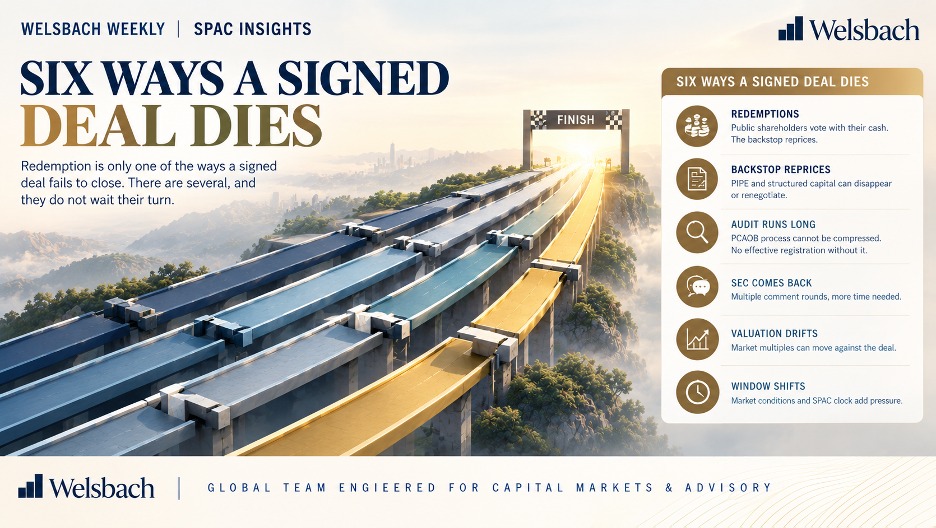
Redemption is only one of the ways a signed deal fails to close. There are several, and they do not wait their turn:
- The backstop reprices. PIPE and structured commitments are priced to a story and a tape. If either wobbles during the gap, investors renegotiate or walk, and the hole the redemptions opened stays open.
- The audit runs long. The PCAOB audit is the long pole. It cannot be compressed at the end, and a registration statement does not go effective without it.
- The SEC comes back. Comment rounds on the merger registration statement run in 30-day cycles, and there is usually more than one. Each round is time the SPAC does not have to spare.
- The valuation drifts. A number set at announcement can look indefensible by closing if comparables move, forcing a down-round or a walk.
- The window shifts. Six to nine months is long enough for the market that made the deal attractive to change its mind.
None of these is sequential. They run at the same time, and any one of them can stall a deal. A stall is dangerous because the SPAC is on a clock, eleven have already liquidated this year, and a wall of liquidation deadlines arrives across 2027 and 2028. The founder who treated signing as the finish line meets the middle of the process with no contingencies left and no time to build them.
How the Survivors Sequence It
The deals that close in this market are not luckier. They are sequenced.
They commit non-redeemable capital before they announce. The low-redemption exceptions in August were engineered, not fortunate. Freenome closed with 24.9% redeemed, IQM with 42.0%, Securitize with 28.5%, each backed by committed capital sized to survive a near-total redemption. The right question is not how much is in the trust. It is how much will still be here at closing that cannot leave, and that number has to be locked before the announcement, not chased after it.
They start the audit before they sign. Because the PCAOB audit is the long pole, the companies that make their timeline begin it while the deal is still being negotiated, not once the registration statement is due.
They run every workstream in parallel, with an owner. Capital, audit, legal, valuation and exchange requirements move together, on a clock, each with a person accountable for it. Sequential execution is how the window closes on you.
They price the deal to survive to closing, and they plan day-one float and research coverage so the first tape is not a distressed one. The companies trading at a few cents on the dollar did not fail on the first day. They were set up to fail at signing.
Standing in the Middle
On one side of every one of these deals is an international growth company with real technology, revenue and a plausible public future. On the other side is the U.S. capital-markets machine, the sponsor, the PIPE and institutional investors, the PCAOB auditors, the securities lawyers, the exchange. Signing a BCA connects the two on paper. Closing requires that all of them stay synchronized for the better part of a year, through the six failure points above, with a clock running.
That is the work between the handshake and the listing, and it is the work Welsbach is built to hold. Our role is not just to find a SPAC. It is to stand in the middle of the transaction and keep the workstreams moving in step, committed-capital structuring sized to real redemption rates, audit and filing coordination, valuation discipline, and the sequencing that turns a signed deal into a listed one. The gap is where value is lost. It is also where a company's advisors either earn their fee or explain why the deal broke.
From Research to Execution
Whether you're evaluating an investment, preparing for a transaction, conducting due diligence, or building materials for a client, it helps reduce the manual work involved in finding, validating, analyzing, and organizing financial information.
Brexy: The AI Operating System for Capital Markets
Brexy is an AI platform for capital markets that brings financial research, company data, documents, models, and institutional knowledge into one secure workspace.
Built for investment bankers, investors, deal teams, and financial advisors, Brexy helps teams research companies, analyze financial information, perform due diligence, build financial models, create investment materials, and move from analysis to execution faster.
One secure, finance-native environment. Less searching. Less switching. More work getting done.
The Window Won't Wait
The window is open right now. Nasdaq is near record highs, volatility is low, and earnings are strong. Windows like this do not stay open on anyone's schedule, and the next one is never guaranteed to arrive before a SPAC's clock runs out.
The companies that will still be standing when it closes are the ones preparing the middle today, before they announce anything. Announced is not closed. The difference between the two is preparation, bought months early, and it is the cheapest insurance in the entire process.
Exploring growth capital or a U.S. listing? Partner with the Welsbach team to make it happen. Email contact@welsbach.sg or reach us through the contact page.
Download
Take this edition with you
Register once to download this Welsbach Weekly edition as a branded PDF, including all charts and exhibits.