
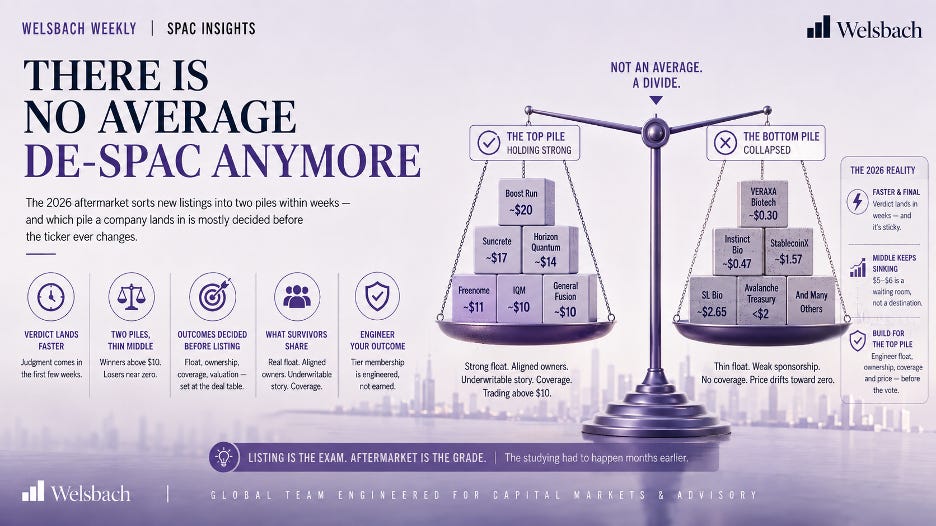
The 2026 aftermarket sorts new listings into two piles within weeks, and which pile a company lands in is mostly decided before the ticker ever changes.
Originally published on Welsbach SPACtacular Insights (Substack)
For years, the standard view on De-SPACs was simple: they underperform on average. While technically true, that framing is increasingly unhelpful. The 2026 market is showing a much wider dispersion of outcomes, making the average far less meaningful than understanding what separates the winners from the losers.
- The "average" is losing relevance: De-SPAC performance in 2026 is no longer clustering around a meaningful middle. The distribution has become increasingly polarised.
- Strong performers are trading well above the typical De-SPAC range: Boost Run at roughly $20, Suncrete at roughly $17 and Horizon Quantum at roughly $14.
- At the other end of the spectrum: VERAXA Biotech at roughly $0.30, Instinct Bio at roughly $0.47 and StablecoinX at roughly $1.57.
- These are not simply variations around a mean. The gap between the strongest and weakest performers represents fundamentally different outcomes.
- The common denominator is only the structure. Companies in both groups used the De-SPAC route to access the public markets, but their post-listing trajectories have been dramatically different.
- The more useful question has changed. Instead of asking "Do De-SPACs work?", the market should be asking "Which outcome is this company likely to achieve?"
- The critical issue is what determines that outcome. The factors separating the winners from the losers are often visible before the bell rings, in the quality of the business, transaction structure, valuation, capitalisation, financing, investor alignment and readiness for the public markets.
The 2026 tape therefore points to a more nuanced conclusion: De-SPACs should not be judged as a single asset class with a single expected outcome. The real opportunity lies in identifying, before closing, what characteristics place a company in the winning pile rather than the losing one.
Two piles, and a thin middle that keeps sinking
Set the closed-deal tape side by side with the traditional IPO market, and the difference is difficult to ignore. Traditional IPOs are clustering relatively close to their issue prices, while De-SPACs are separating sharply into distinct performance groups.
- Holding at or above the $10 issue price: Boost Run at $20, Suncrete at $17, Horizon Quantum at $14, Freenome at $11, and IQM and General Fusion at $10.
- The larger group has fallen sharply toward zero: VERAXA, Instinct Bio, StablecoinX, SL Bio at $2.65 and Avalanche Treasury below $2.
- A small middle cluster sits around $5-$6: Teamshares, Einride, Factorial and Enhanced Games. Most are drifting lower rather than showing a clear recovery.
- The contrast with traditional IPOs is striking: the 20 most recent traditional IPOs have a median return of approximately +3.4% from offer price to current price.
The takeaway is clear: traditional IPOs tend to cluster around their issue price; De-SPACs tend to polarise. In this market, the middle is increasingly a waiting room, not a destination.
The verdict lands faster than it used to
What is new in 2026 is not that some De-SPACs fail. It is the speed and finality of the judgment.
A traditional company that IPOs poorly has quarters to prove itself before the market makes up its mind. A De-SPAC does not get that grace. The redemption vote, the unlock schedule and the sudden arrival of a public float all compress the market's assessment into the first few weeks of trading. By the time management has held its first earnings call, the tape has usually already decided which pile the company is in.
And the verdict is sticky. A De-SPAC that breaks well below $10 in its opening weeks rarely climbs back. Thin float, weak sponsorship and no research coverage feed on each other, and there is no natural buyer to reverse the slide. The uncomfortable implication is that the outcome most founders assume they will fix through investor relations after listing is, in practice, close to locked before listing.
What the survivors quietly share
Strip out the structure and the sector noise, and the companies holding the top pile tend to have four things in common.
A real float. Enough non-redeeming capital stayed in the deal to leave shares that actually trade, so price is set by ongoing demand rather than by a handful of forced sellers. Boost Run took essentially no redemptions; Freenome and IQM paired low-to-moderate redemptions with committed capital.
Ownership that wants to be there. Institutions that did genuine work on the business, plus insiders whose lock-ups and incentives keep them aligned rather than sprinting for the exit at the first unlock.
A story the public market can actually underwrite. Recognisable revenue, a sector with a live tailwind - quantum, fusion, advanced manufacturing, applied AI - and numbers clean enough that a research analyst can build a model without heroic assumptions.
Someone covering the stock. Sponsors and advisors who arranged research coverage and a market-making presence so the company is not orphaned the week after closing.
None of these can be assembled after the fact. Each is the product of choices made during the transaction: who was let into the PIPE, how the lock-ups were written, how the valuation was set, which banks were around the table.
The part founders get backwards
Most first-time issuers treat the listing as the finish line and the aftermarket as something to manage once they get there. The tape says the opposite. The listing is the exam, the aftermarket is the grade, and the studying had to happen months earlier.
- The benchmark that matters is not the "average De-SPAC." It is which of two piles you land in, and that is largely pre-determined by the shape of the deal you sign.
- The first two weeks are graded and near-permanent. You cannot rescue a broken open with communication; the buyers who would have caught it were supposed to be lined up before the vote.
- Tier membership is engineered, not earned in the aftermarket. Float, ownership quality, coverage and a defensible price are set at the deal table.
Building for the top pile
The companies that end up trading are the ones that worked backward from the aftermarket while the deal was still being structured. In practice that means shaping the shareholder register deliberately rather than taking whoever fills the PIPE, writing lock-ups and incentives that keep insiders aligned through the first unlocks, setting a valuation the market can defend instead of the highest one on offer, and securing research coverage and market-making before the ticker changes rather than after the stock is already orphaned.
It is unglamorous, and it happens in the weeks when everyone else is focused on getting to signing. That is exactly why it separates the two piles.
Where Welsbach's work sits
On one side of every listing is an international growth company that has spent years building something real. On the other is a public market that will grade it in a fortnight and rarely revise the mark. The distance between those two facts is where a company either sets itself up to trade or quietly consigns itself to the second pile.
Welsbach works on that distance before it becomes visible on a screen. That means helping shape the register toward institutions that intend to hold, structuring lock-ups and incentives that keep insiders aligned, pressure-testing valuation against what the aftermarket will actually support, and arranging the research coverage, follow-on capacity and board and CFO support a newly public company needs from day one rather than month six. For the cross-border businesses that make up much of its work across Asia, the Gulf and Europe, it also means presenting the company in the terms U.S. institutional investors reward.
With a team drawn from Goldman Sachs, J.P. Morgan, Deutsche Bank and Macquarie, and more than $20 billion of transaction value across fifteen mandates including Evolution Metals (Nasdaq: EMAT), the firm's aim is narrow and specific: that when the market grades the company, it grades it into the first pile.
From Information to Action
Modern finance teams don't have an information problem. They have a workflow problem.
Research sits in reports. Financial data lives across multiple platforms. Deal documents sit in data rooms. Company knowledge is spread across emails, shared drives, and internal systems. The real challenge is bringing all of that context together, finding what matters, and turning it into work that moves a deal or investment forward.
That's What Brexy is Built For
Brexy is a purpose-built AI platform for capital markets, designed by people who understand how financial workflows actually work. It connects to the data and systems financial teams already rely on and helps dealmakers, investors, bankers, and advisors research, analyze, model, conduct diligence, generate investment materials, and execute workflows all within one secure, finance-native environment.
Instead of another AI chatbot that simply answers questions, Brexy is designed to understand financial context and execute the work.
If your team is spending too much time moving between documents, data rooms, research platforms, models, and internal knowledge, Brexy is worth exploring.
Learn more at brexy.ai or book a demo.
The tape keeps the score
The most honest scorekeeper in this market is the price a week after closing. It is quick, it is public, and it is rarely generous to companies that assume they could sort out the aftermarket later. The founders who will look good on that screen are not the ones with the best post-listing communications plan. They are the ones who built the register, the float, the coverage and the price into the deal itself, back when it was still soft enough to shape. By the time the ticker changes, the concrete has usually set.
Exploring growth capital or a U.S. listing? Partner with the Welsbach team to make it happen. Email contact@welsbach.sg or reach us through the contact page.
Download
Take this edition with you
Register once to download this Welsbach Weekly edition as a branded PDF, including all charts and exhibits.