
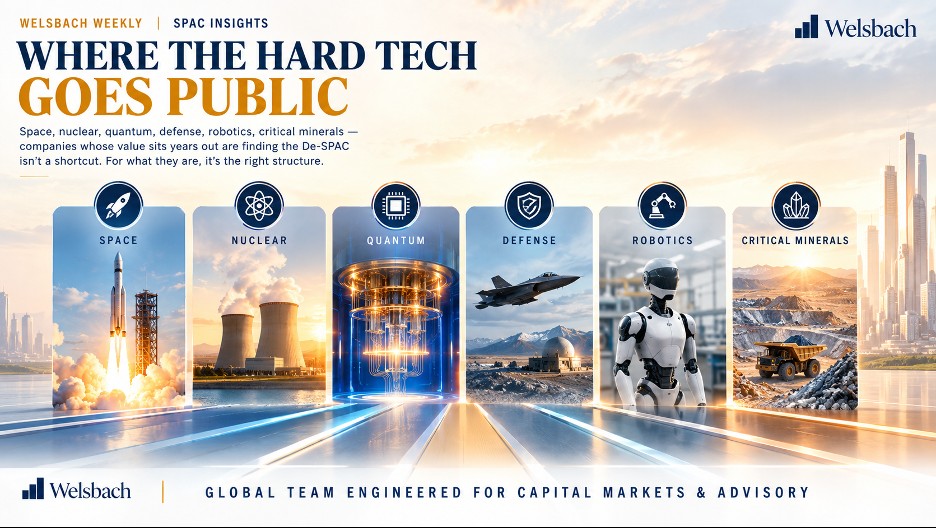
Space, nuclear, quantum, defense, robotics, critical minerals: companies whose value sits years out are finding that the De-SPAC isn't a shortcut. For what they are, it's the right structure.
Originally published on Welsbach SPACtacular Insights (Substack)
Look at what actually went public through SPACs this year, and a pattern jumps out. A fusion company. Two quantum-computing firms. A humanoid-robotics maker. A launch-propulsion business. A critical-minerals refiner. In August alone, sponsors announced a cluster of space deals within days of each other.
These are not software companies with clean recurring revenue and an easy comparison set. They are capital-hungry, long-horizon businesses whose worth lies in machines and molecules that don't exist at scale yet. And they are not choosing the De-SPAC because a traditional IPO turned them away. They're choosing it because, for what they are, it fits better.
Our weekly edition reframes the De-SPAC from "shortcut" to "the correct instrument for a milestone business," then shows that its payoff depends on a financeable roadmap and committed, correctly sized capital, which is matching-and-structuring work. A deep-tech founder who accepts the thesis concludes, privately: we need our roadmap made financeable and matched to money that understands it, before we go out.
Rockets, Reactors, Robots
The deal sheet has tilted toward hard tech, and it isn't subtle. Recent and announced combinations run through Pasqal and IQM in quantum, General Fusion in fusion, Agility Robotics and FORT Robotics in robotics, Ursa Major and Astrum Space in propulsion and space, Nth Cycle and Tactical Resources in critical minerals.
Specialist money showed up alongside them, not token checks. Ursa Major's announced combination carried a $350 million PIPE; Pasqal closed with $250 million committed; Agility Robotics drew $200 million; IQM, $145 million. And the broader tape agrees with the direction: for 2026 to date, Energy is up more than 40% and Technology more than 20%. Capital wants exposure to hard assets and frontier compute, and the vehicles are the pipe that carries it there.
| Company | Sector | Committed capital |
|---|---|---|
| Ursa Major | Propulsion and space | $350 million PIPE (announced) |
| Pasqal | Quantum | $250 million committed |
| Agility Robotics | Robotics | $200 million |
| IQM | Quantum | $145 million |
None of this is an accident of fashion. The forces pulling these companies public are structural: defense budgets rebuilding, an industrial policy scramble to secure critical minerals and domestic manufacturing, a nuclear revival, and an AI build-out that needs power, chips and physical infrastructure at once. These are exactly the businesses that need large, patient capital to build real things and exactly the ones a public listing, done right, is built to fund.
Comps Can't Price a Roadmap
A traditional IPO prices you off what you have already done. Trailing revenue, margins, a set of public comparables, book-built across hundreds of investors in a two-week window. That machine works beautifully for a company whose value is visible in the rear-view mirror.
Hard tech is not that company. A reactor, a launch system, a fab, a mine, the value sits in a five-to-ten-year buildout and a sequence of milestones, most of them still ahead. There is no clean public comp for a fusion business. Trying to book-build a story like that to a broad crowd in two weeks usually ends in a broken deal or a punitive price.
The De-SPAC runs on different rails. You negotiate a value bilaterally with a sophisticated sponsor. You put a forward roadmap in front of investors who understand the science well enough to underwrite it. You raise committed capital sized to the buildout rather than to last year's numbers. For a milestone business, that is not a workaround. It is the more honest mechanism.
It also changes who you are selling to. A book-built IPO scatters a story across a crowd, and a crowd defaults to the comp when it cannot value the science. A De-SPAC lets you concentrate the conversation on a handful of investors willing to do the work, read the physics, size the program, price the milestones. Concentrated, informed capital is exactly what a company with a ten-year build needs. It is the difference between being valued by people who understand the machine and being repriced by people who never did.
The Right Rail Still Derails
A structure that fits is not the same as a deal that works, and this is where founders get careless.
The same hard-tech names carry some of the market's ugliest redemption prints and its most violent post-listing tapes. General Fusion closed with more than 90% of its trust redeemed. Several of this year's steepest post-listing declines were long-horizon stories the market simply stopped believing after the first quarter of ownership.
The reason is the flip side of the same coin. A story about value years out is only as strong as its credibility today. If the milestones are vague, if the capital isn't actually committed, if the roadmap needs money the deal doesn't deliver, then the "patient capital" evaporates the moment the stock opens. The structure that lets you sell the future also punishes a future no one believes. The rail is right; it still derails companies that board it unprepared.
The Rail Has Winners
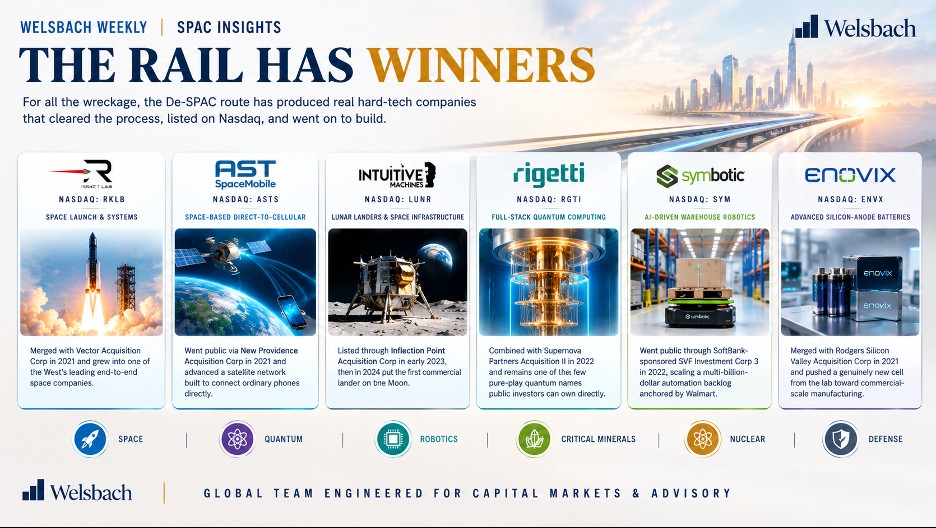
For all the wreckage, the De-SPAC route has produced real hard-tech companies that cleared the process, listed on Nasdaq, and went on to build. These are precedents a founder can point to, not hypotheticals.
- Rocket Lab (NASDAQ: RKLB): space launch and systems. Merged with Vector Acquisition Corp in 2021 and grew into one of the West's leading end-to-end space companies, flying its Electron rocket to orbit repeatedly while developing the larger Neutron.
- AST SpaceMobile (NASDAQ: ASTS): space-based direct-to-cellular. Went public via New Providence Acquisition Corp in 2021 and advanced a satellite network built to connect ordinary phones directly, underpinned by agreements with major wireless carriers.
- Intuitive Machines (NASDAQ: LUNR): lunar landers and space infrastructure. Listed through Inflection Point Acquisition Corp in early 2023, then in 2024 put the first commercial lander on the Moon, a milestone no traditional IPO peer matched.
- Rigetti Computing (NASDAQ: RGTI): full-stack quantum computing. Combined with Supernova Partners Acquisition II in 2022 and remains one of the few pure-play quantum names public investors can own directly.
- Symbotic (NASDAQ: SYM): AI-driven warehouse robotics. Went public through SoftBank-sponsored SVF Investment Corp 3 in 2022, scaling a multi-billion-dollar automation backlog anchored by Walmart.
- Enovix (NASDAQ: ENVX): advanced silicon-anode batteries. Merged with Rodgers Silicon Valley Acquisition Corp in 2021 and pushed a genuinely new cell from the lab toward commercial-scale manufacturing.
What they share is not luck. Each was a long-horizon, capital-intensive story the public market chose to fund on a roadmap and each brought what the next section describes: credible milestones, committed capital, and backers who understood the science. The rail works. It rewards the prepared.
Sell the Roadmap, Fund the Buildout
The deep-tech companies that get funded and stay funded do four things.
- They make the roadmap financeable, not just visionary. Specific, dated, capital-linked milestones: what gets built, by when, for how much. Not a market-size slide.
- They size the raise to the next hard milestone, plus a margin. Enough committed, non-redeemable capital to reach a real, value-creating proof point without crawling back to the market underwater. Trust cash, as we've written before, is not that capital.
- They bring anchors that signal. Strategic investors, offtake partners, or government and defense customers whose presence tells the market the science works and the demand is real.
- They pick a sponsor who understands the sector. Sector-literate money prices a milestone; generalist money on a deadline fears it. The right partner is not the one with a vehicle and a clock, but the one who can read the roadmap.
Capital Markets Has a Strange Problem
The next evolution of capital markets may not be about giving every professional an AI assistant. It may be about giving every desk a team of AI agents.
Brexy AI Studio is designed around the idea that agents should work in teams, not in isolation. A banker can create or deploy specialised agents, bring them into a workflow, have them coordinate across tasks, and keep a human in the loop for review and approval.
The goal is not to replace the people running the desk. It is to give every desk a much larger operating capacity.
Research agents. Valuation agents. M&A agents. Diligence agents. DCM agents. Compliance agents. Portfolio-monitoring agents - coordinated as teams and working alongside the humans who own the decisions.
That is the direction we believe capital markets are heading:
- Agents doing the work.
- Humans directing the work.
- Institutions owning the outcome.
Brexy Agent Studio is coming soon, and the waitlist is now open. If you're thinking about what an AI-native deal team, investment team, or financial institution could look like, we'd love to have you on the journey.
Welsbach - Matching the Machine to the Money
On one side is a company building something genuinely hard, a rocket engine, a reactor, a quantum stack, whose worth is a roadmap and a team, not a trailing P&L. On the other is a market that will fund exactly that, but only when the story is structured, the milestones are credible, and the capital is sized correctly.
Making that match is the work, and it is easy to get wrong: the wrong sponsor prices a milestone company like a software business and the deal dies in diligence.
Welsbach's Target-to-SPAC Matching scores candidates on sponsor fit and sector literacy, not merely on which vehicle is available and ticking. The platform structures the milestone story, lines up specialist and strategic capital sized to the buildout, and coordinates the audit, filings and governance running underneath it. Standing in the middle of the deal, our job is to connect the machine to money that understands what it is looking at and to make the roadmap financeable before it ever meets an investor.
Patient Capital Has an Impatient Clock
The window for this is open and unusually favorable. Capital is rewarding hard assets and frontier technology, and sponsors are actively hunting these exact companies. That combination does not come around often.
But "patient" capital sits inside vehicles on a deadline, and the appetite that rewards a fusion company this year can cool by the next. A roadmap that isn't financeable when the window is open does not get a second showing when it closes. The hard-tech companies that get funded are the ones whose case is built before anyone asks to see it. Build it first. The capital for the hard stuff is here, it just won't wait for you to get ready.
Exploring growth capital or a U.S. listing? Partner with the Welsbach team to make it happen. Email contact@welsbach.sg or reach us through the contact page.
Download
Take this edition with you
Register once to download this Welsbach Weekly edition as a branded PDF, including all charts and exhibits.